What is a Technical Program Manager
• public
If you've stumbled across this post, you're probably Googling some variation of "what does a Technical Program Manager actually do?" or "how is a Technical Program Manager different from a Program Manager?" You're not alone. The title confusion in program and product management is common and it trips up everyone from new grads to seasoned professionals trying to build their first TPM team.
Let me clear things up.
The Alphabet Soup: PM, PgM, PjM, and TPM
Before we dive into what makes a TPM unique, let’s define the full cast of characters:
Product Manager (PM)
A Product Manager owns the what and why of a product. They’re responsible for:
- Defining the product vision and strategy
- Prioritizing features based on customer needs and business goals
- Working with engineering, design, and stakeholders to ship products users love
- Measuring success through metrics like adoption, retention, and revenue
Product Managers are the voice of the customer. They spend their time talking to users, analyzing data, and making decisions about what gets built next.
Program Manager (PgM)
A Program Manager coordinates multiple related projects toward a shared strategic goal. Think of them as the conductor of an orchestra. They’re responsible for:
- Managing interdependencies between projects
- Tracking milestones across workstreams
- Communicating progress to leadership
- Ensuring alignment between teams working toward a common objective
Program Managers focus on how work gets organized and delivered at scale. They often operate at a higher level of abstraction than individual projects.
Project Manager (PjM)
A Project Manager owns the execution of a single, defined project. They’re responsible for:
- Creating project plans with clear scope, timeline, and resources
- Tracking tasks and deliverables
- Managing risks and issues
- Keeping the project on track and on budget
Project Managers are laser-focused on delivery. Their job is to take a defined scope and get it across the finish line.
Technical Program Manager (TPM)
And now we arrive at the star of our show. A Technical Program Manager is a Program Manager who operates in a technical environment and has enough technical depth to be effective in that context.
TPMs are responsible for:
- Driving complex, cross-functional technical programs
- Coordinating across engineering teams, infrastructure, and platform organizations
- Understanding technical systems well enough to identify risks, dependencies, and trade-offs
- Translating between technical and non-technical stakeholders
- Managing programs involving technical complexity: migrations, platform builds, infrastructure upgrades, system integrations
The key differentiator is the word “technical.” TPMs aren’t just coordinating schedules - they’re operating in the weeds of engineering work, understanding enough about systems, architecture, and technical decisions to add real value.
Where Does TPM Fit in an Organization?
TPMs typically sit within the engineering organization, though the exact structure varies by company:
- Embedded in Engineering: Some companies have TPMs report directly to engineering leadership, working as partners to engineering managers and directors.
- Central TPM Organization: Others have a dedicated TPM org that supports programs across multiple engineering teams.
- Hybrid Model: Many companies use a mix, with some TPMs embedded and others operating from a central function.
Regardless of structure, TPMs work at the intersection of engineering execution and organizational coordination. They’re the connective tissue that keeps complex technical programs on track.
The Venn Diagram of Roles
Here’s how I think about the overlap:
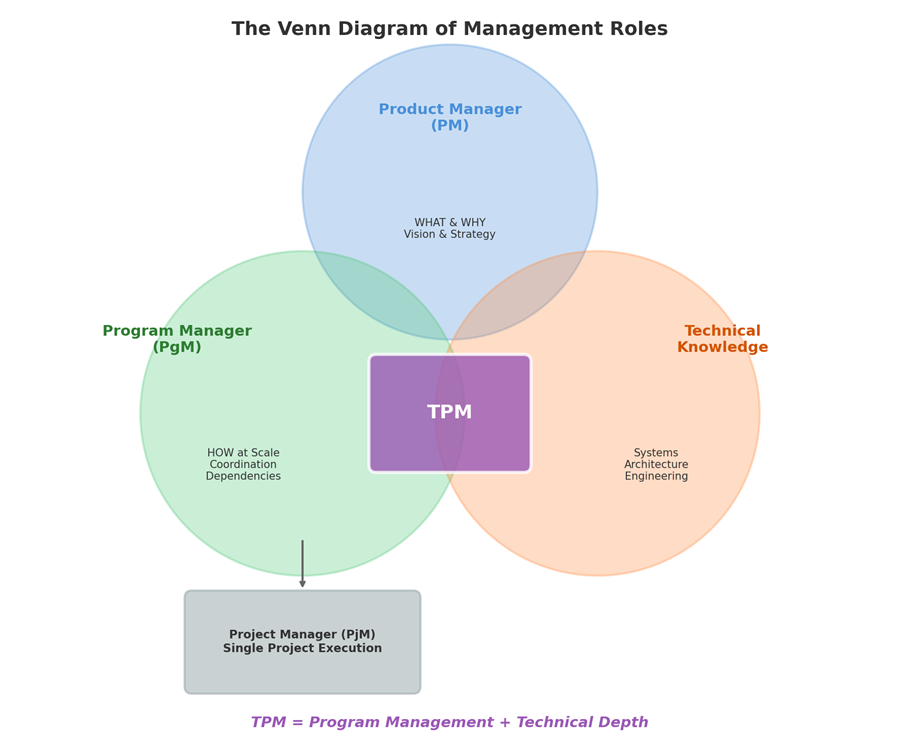
TPM = Program Management + Technical Depth
A TPM combines the coordination skills of a Program Manager with enough technical understanding to navigate engineering environments effectively.
What “Technical” Actually Means for TPMs
This is the question that trips people up the most. Let me be clear: TPMs are not engineers, and they don’t need to be.
“Technical” for a TPM typically means:
1. Fluency in Technical Concepts: You can read an architecture diagram, understand what a database migration involves, and follow a conversation about API design.
2. Ability to Ask Good Questions: You don’t need to write the code, but you should know what questions to ask: “What are the dependencies?” “What could go wrong?” “How does this integrate with system X?”
3. Understanding of Technical Risk: You can identify when something is technically complex or risky, even if you can’t solve the problem yourself.
4. Credibility with Engineers: You’ve built enough technical knowledge that engineers trust you to understand their work and represent it accurately.
5. Translation Skills: You can take technical concepts and explain them to executives, product managers, and other non-technical stakeholders.
The depth of technical knowledge varies widely across TPM roles. Some TPMs have computer science degrees and years of engineering experience. Others built technical fluency over time without ever writing production code. Both paths are valid.
Day-to-Day: What Does a TPM Actually Do?
A typical week for a TPM might include:
Meetings (30-50% of time)
- Program syncs with engineering leads
- Stakeholder alignment sessions
- Executive reviews and status updates
- Technical design reviews (yes, even without being a software engineer)
- Risk and dependency discussions
Async Work (25-35% of time)
- Writing status updates and executive summaries
- Updating program documentation and roadmaps
- Building dashboards and tracking progress
- Drafting communication plans
- Preparing for upcoming milestones
Problem-Solving and Firefighting (25-35% of time)
- Unblocking teams when dependencies slip
- Escalating issues that need leadership attention
- Facilitating decisions when teams disagree
- Re-planning when priorities shift
The ratio varies based on program phase. Early in a program, you spend more time in planning and alignment. During execution, it’s more tracking and problem-solving. Near launches, expect firefighting to spike.
Signals You Might Be a Good Fit for TPM
If you’re wondering whether TPM is right for you, here are some positive signals:
- You enjoy organizing complex work and bringing order to chaos
- You’re curious about how technical systems work
- You get energy from working across teams and building relationships
- You’re comfortable with ambiguity and can create structure where none exists
- You’re a strong communicator who can tailor your message to different audiences
- You find satisfaction in enabling others to do their best work
Common Misconceptions About TPM
“TPMs are just glorified project managers.”
No. While there’s overlap, TPMs operate in technically complex environments and need technical fluency to be effective. The technical depth is the differentiator.
“TPMs tell engineers what to do.”
Not quite. TPMs coordinate, align, and facilitate but they don’t have direct authority over engineering teams. The role is about influence, not command.
“You need a CS degree to be a TPM.”
False. Many successful TPMs come from non-engineering backgrounds. What matters is your ability and willingness to build technical literacy over time.
“TPM is just a stepping stone to PM.”
Not quite. TPM is a complete and respected career path on its own. Some TPMs branch out to other roles while many others go on to become Directors, VPs, and even CTOs.
Where to Go From Here
If you’re exploring a career in TPM, you’re in the right place. This blog is specifically designed for people who want to break into TPM or grow their TPM skills, especially if you’re coming from a non-technical background.
In upcoming posts, I’ll cover:
- My personal journey from PM to TPM (what worked, what didn’t)
- Do you actually need to know how to code?
- The core skills every TPM needs
- How the internet actually works (and why TPMs should understand it)
──────────────────────────────────────────────────
Key Takeaways
1. TPM = Program Management + Technical Depth. The “technical” is what differentiates it from general program management.
2. TPMs coordinate complex technical programs across engineering teams, working at the intersection of execution and organizational alignment.
3. “Technical” doesn’t mean “engineer.” You need fluency, not mastery. The goal is credibility and effectiveness, not writing code.
4. TPM is a legitimate career path, not a consolation prize for people who couldn’t become PMs or engineers.
5. You can break into TPM from a non-technical background. It takes work, but it’s absolutely possible.
──────────────────────────────────────────────────
Have questions about the TPM role? Drop them in the comments
──────────────────────────────────────────────────
Related Reading:
- A Day in the Life of a TPM
- Do You Need to Know How to Code to Be a TPM?
- How the Internet Actually Works: A TPM’s Guide